Csiba v Samuel
JUDGMENT
Introduction
1. On 22 February 2019, Mr Csiba was appointed Principal Legal Officer for the Office of the Ombudsman. However, from 2020 until Mr Csiba’s employment was terminated summarily on 3 October 2024, he was employed under a series of fixed term employment contracts as a “legal advisor”. He believes that despite the contractual arrangements, he carried out the role and duties of the First Principal Legal Officer (“FPLO”) from 2020. Mr Csiba asserts that in 2020 he was promoted to the role of FPLO.
2. In the claim, Mr Csiba said that Mr Bulu’s appointment as Ombudsman ended in July 2024, but did not specify when that was. Mr Bulu was appointed as Ombudsman by the President under the Constitution on 10 July 2019 for a 5 year term. [1] Thus, Mr Bulu’s term as Ombudsman ended on 10 July 2024, [2] and the position was vacant. Mr Bulu was appointed as Acting Ombudsman by the President with effect from 11 July 2024. Also, prior to his appointment ending, Mr Bulu is said to have delegated his powers as Ombudsman to Mrs Dora Samuel pursuant to s 14 of the Ombudsman Act.
3. Mr Csiba asserts he was demoted from the FPLO role between July and August 2024, when Mr Greg Takau was appointed as Acting FPLO. This appointment caused Mr Csiba considerable concern and culminated with him sending a letter to Mrs Dora Samuel on 2 October 2024 expressing his concern and seeking to be reinstated. Mrs Samuel’s response was to summarily terminate Mr Csiba’s employment by letter the next day, 3 October 2026.
4. Mr Csiba filed an employment claim. He said that at all relevant times he had a fixed term employment contract. In the claim he alleged:
a. That he was demoted from the position of FPLO; and
b. His employment was unlawfully terminated without notice by Mrs Samuel.
5. By way of relief, the orders sought by Mr Csiba including the following:
a. That the decision to demote him was unjustified.
b. That his employment was terminated unlawfully.
c. Compensation and damages for breach of the employment contract.
6. The claim was defended on the basis that Mr Csiba was not demoted from the role of FPLO because he had never been appointed to that position. Further, his employment was not unlawfully terminated; rather that his employment ceased on 21 September 2024 by mutual agreement.
Issues
7. Mr Tevi filed a statement of agreed and disputed facts and issues. He did not confer with Mr Ngwele. However, there is no real dispute as to the relevant issues, which Mr Ngwele also addressed in his written submissions.
8. The issues for determination are:
a. Was Mr Csiba demoted from the position of First Principal Legal Officer (“FPLO”)?
b. Was Mr Csiba’s employment unlawfully terminated on 3 October 2024?
c. Did Ms Samuel have the legal authority or power to make decisions in relation to Mr Csiba’s employment?
d. Should Ms Samuel, Mr Takau and Mr Simon be personally liable for decisions made during the course of their employment at the Office of the Ombudsman?
e. If Mr Csiba was unjustifiably demoted or his employment unlawfully terminated, what should the award for damages be?
Mr Csiba’s employment with the Office of the Ombudsman
9. Mr Csiba was appointed as Principal Legal Officer at the Office of the Ombudsman on 25 March 2019. [3] He was appointed by the Public Service Commission. His annual salary was VT 2,693,000. There was no end date to his employment.
10. This changed in 2020 when Mr Csiba and the Ombudsman, Mr Bulu entered into a fixed term employment agreement. This was a fixed term contract from 21 April 2020 until 10 July 2024. The change from permanent employee to a contract employee appears to relate to Mr Csiba’s age; specifically, that he had reached retirement age. Under that agreement, Mr Csiba was appointed as a “legal advisor”, with an annual salary of VT 2,693,000. Mr Csiba, however, alleges that in 2020 he was promoted to FPLO. [4] His evidence was that he was not paid at the salary of a legal advisor but rather the salary of the FPLO as the budget for the position of legal advisor had not been appropriated by the State. [5] Mr Csiba did not say what the salary for either position was.
11. On 16 January 2023, Mr Csiba’s employment agreement was extended from 21 July 2024 to 10 July 2028. This agreement did not form part of the evidence. However, it is referred to in an agreement entered into between Mr Bulu, as Ombudsman, and Mr Csiba on 5 July 2024. I will refer to this agreement in more detail shortly.
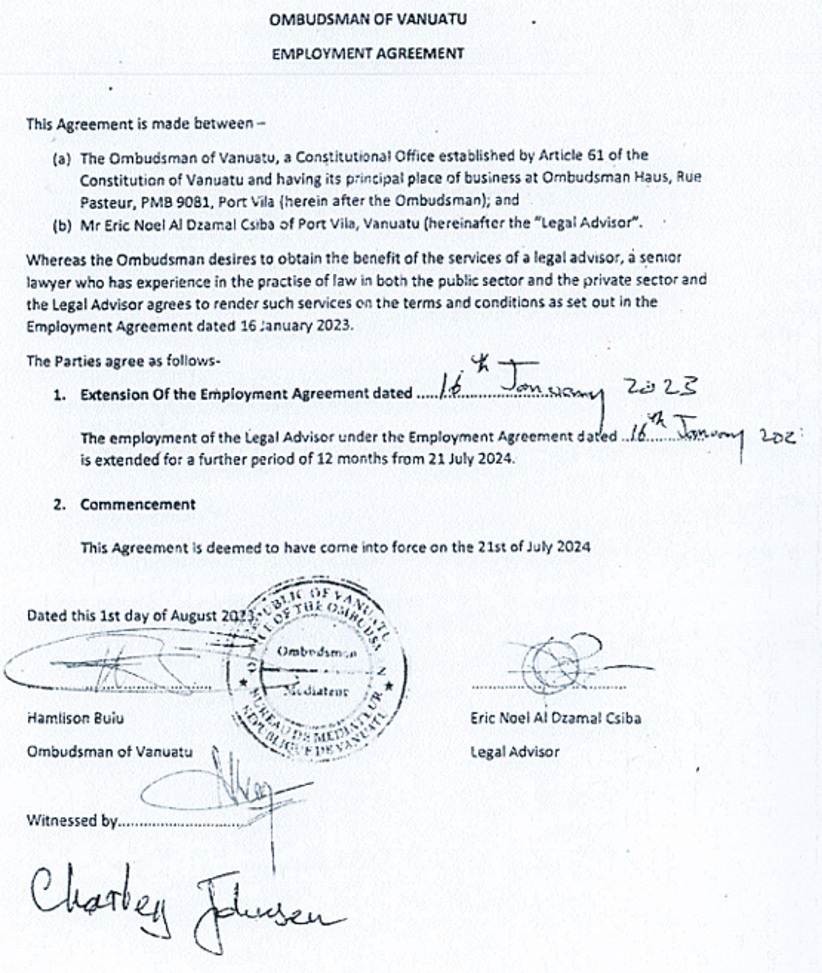
12. There are two other employment agreements. There is an agreement 33dated 1 August 2023 extending the employment agreement of 16 January 2023 for a period of 12 months from 21 July 2024. In his evidence, Mr Csiba asserted that the date of that agreement was in fact 1 August 2024. I set out the agreement below:
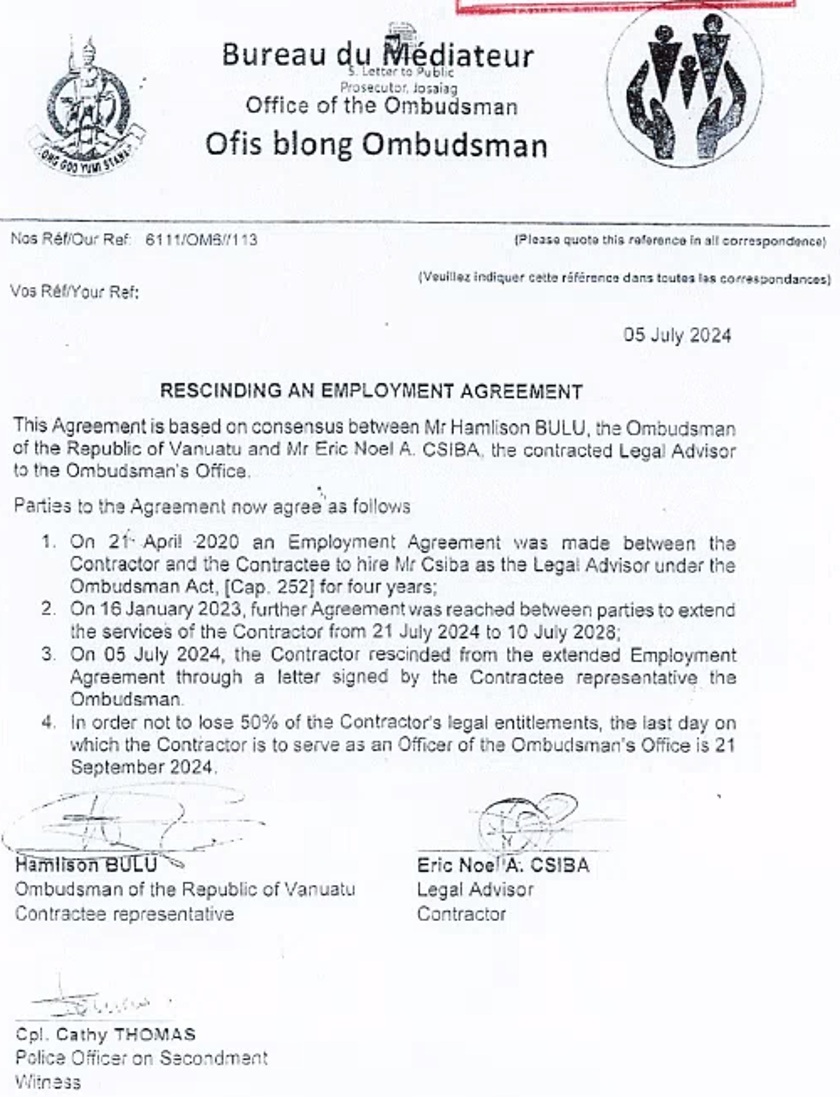
13. Then there is a rescission agreement dated 5 July 2024 (“the rescission agreement”). The rescission agreement refers only to the 16 January 2023 agreement to extend Mr Sciba’s term for 4 years from 21 July 2024 to 10 July 2028. It does not refer to the 1 August 2023 12 month extension agreement. Pursuant to that agreement, Mr Csiba rescinded the extended employment agreement. Relevantly, it was a term of the rescission agreement that Mr Csiba’s employment was to end on 21 September 2024.
14. The rescission agreement is a critical document, and I set it out here:
15. All the employment agreements were signed by Mr Bulu as Ombudsman.
Was Mr Csiba unjustifiably demoted?
16. The claim, as pleaded, in relation to demotion was that between July and August 2024, Mrs Samuel demoted Mr Csiba from the position of FPLO and gave it to another lawyer, Mr Takau. That is a statement of fact and not a cause of action. [6] The cause of action is at best inadequately pleaded. It is unclear whether the cause of action is that Mr Csiba’s employment contract was varied by the parties (expressly or impliedly) so that the position of FPLO became his contractual position, which was then breached by the demotion. Alternatively, it may be breach of the fixed term employment contract.
17. Mr Csiba did not plead that the demotion was a breach of the Employment Act [CAP 160], which provides only a limited remedy for breach of contract by an employer, unlike the termination of employment provisions. Pursuant to s 53 of the Employment Act, an employee may terminate the contract with remuneration entitlements, if the employer either ill-treats the employee, or commits some other serious breach of the terms and conditions of the employment contract. That is not applicable as Mr Csiba did not exercise the discretion to terminate the employment agreement.
18. The importance of pleadings was recently reiterated by the Court of Appeal in Ngwele v Republic of Vanuatu [2026] VUCA 50. The Court said:
23. This Court has emphasised on a number of occasions the importance of pleadings to the proper conduct of a trial (see, for example, Richard Lo trading as LCM v Alick Sagan [2003] VUCA 16; Pakoa Toara & Sandy Bell v Moi Dinh and Kalo Kalran [2004] VUCA 25). The pleadings must identify the issues with precision so as to ensure that the trial is conducted properly and each party knows the issues it must meet, the pleas it may wish to raise in response to the other party’s case and the evidence, both oral and documentary, it considers will be relevant at the trial. There are two reasons for this. First, a trial judge must be in a position to identify all the issues in the case and to address them in his or her judgment. Furthermore, where there is an appeal, the appeal Court must be in a position to identify the precise issues raised at the trial.
19. What is to be assessed is whether there was a breach of Mr Csiba’s employment agreement? I consider that turns on whether his employment agreement was varied by the parties’ conduct. As I have said, the lack of proper pleading of the cause of action is unhelpful. While I acknowledge Mr Csiba’s contention that Mrs Samuel had no authority to make employment decisions, that only becomes a relevant issue if the Court finds that Mr Csiba was demoted, and that such demotion was a breach of the employment agreement.
20. Mr Csiba asserts, as I have said, that he was promoted to FPLO in 2020. There is no evidence as to how he was promoted. There was, for example, no letter confirming the promotion. There is no evidence of an oral agreement. However, it seems tolerably clear that Mr Csiba did carry out the role/duties of FPLO over a 4 year period. During cross examination, Mr Csiba said that in his job description, ( which he did not have access to) there was a provision that he could undertake other roles on the instruction of the Ombudsman, which is why he carried out the role of FPLO.
21. Mr Bulu was not called by any of the parties to give evidence. That is curious given that he was responsible for Mr Csiba’s employment agreements and could have given evidence as to Mr Csiba’s position at the Ombudsman’s Office. There are two pieces of evidence of Mr Bulu’s view as to Mr Csiba’s position as FPLO. As I will explain, one of those pieces of evidence is inadmissible hearsay and must be put to one side, and I give the other piece of evidence limited weight.
22. In 2025, Mr Bulu sought legal advice from the Attorney General as to employment issues relating to Mr Csiba. Such advice was provided by the Attorney General by letter dated 4 September 2025, which was annexed to Mrs Samuel’s sworn statement. In the letter (page 2), it is recorded that:
“2. In 2020, your office became independent from PSC. Mr Csiba was promoted to the position of First Principal Legal Officer and Manager of the Legal Services Unit, with an annual salary of VT 3,408,300.”
23. I infer that information was provided to the Attorney General by Mr Bulu. Because Mr Bulu was not called to give evidence, what he told the Attorney General is a hearsay statement. A hearsay statement is a statement made by a person other than a witness and is offered in evidence to prove the truth of its contents. It is a piece of evidence which supports Mr Csiba’s contention he was promoted to FPLO in 2020. Therefore, it is relied on for its truth.
24. Under s 149 of the Evidence Act No. 18 of 2025 (“the Evidence Act”), a hearsay statement is not admissible except as provided by the Act or any other law. So, what Mr Bulu told the Attorney General was inadmissible hearsay, unless it was admissible under s 150 of the Act, which sets out preconditions for admissibility of hearsay statements. It provides that a hearsay statement is admissible if:
(a) The circumstances relating to the statement provide reasonable assurance the statement is reliable; and
(b) either:
(i) the maker of the statement is unavailable as a witness; or
(ii) in any case where the court considers that undue expense and delay would be caused if the maker of the statement were required to be a witness.
25. On a s 150 analysis, the evidence could not be admissible because there was no evidence that Mr Bulu was unavailable as a witness. [7]
26. The other piece of evidence is a hearsay statement but would be admissible as a business record. [8] On 25 June 2024, Mr Bulu gave Mr Csiba a reference letter. In that letter, Mr Bulu records that Mr Csiba was FPLO in the legal team unit, and that he headed the legal team. It then becomes a matter of weight. Because Mr Bulu did not give evidence, those statements were not subject to cross examination, particularly as to the circumstances of Mr Csiba carrying out the role of FPLO, when his contractual position was a legal advisor. I do not place much weight on that evidence, for that reason.
27. Mr Csiba accepted in cross examination that under his employment agreements, he was a “legal advisor”. The first fixed term agreement was signed on 24 April 2020. The duties of a legal advisor are set out in that agreement as follows:
“2. Description of services
The legal advisor shall perform the following duties in a professional manner:
(a) Assist the Ombudsman review complaints lodged with the Office of the Ombudsman to determine whether a case is made out or the matter is of public interest that warrants an enquiry to be carried out and determine legal and or constitutional issues arising from each such complaint;
(b) Assist the Ombudsman with applications plus supporting documents for interlocutory orders to the Courts under s 24(1)(b) of the Ombudsman Act;
(c) Prepare search warrants on behalf of the Ombudsman;
(d) Attend court to assist the Ombudsman on matters before the courts where required;
(e) Assist in the provision of legal and constitutional law advice on issues that may be referred to the Legal Advisor by the Ombudsman;
(f) Prepare amendments of relevant laws and regulations relating to the Ombudsman;
(g) Attend Ombudsman’s meetings and other meetings when required;
(h) Review and provide legal opinion on investigation cases;
(i) Any other duties as may be required by the Ombudsman.”
28. As set out in Mrs Samuel’s letter of 25 July 2024 appointing Mr Takau as Acting FPLO, one of the duties of the FPLO is to oversee the operations of the unit. However, the position description and duties of legal advisor as set out in Mr Csiba’s employment agreement does not include responsibility for leading the legal services unit. An unanswered question is why the employment agreement did not record Mr Csiba’s position as FPLO, if he was appointed to that role.
29. The organisational structure of the Ombudsman’s Office formed part of the evidence. There was no evidence from Mr Csiba as to how the legal advisor position fitted into the organisational structure of the Ombudsman’s Office. The position does not exist in the formal structure. The head of the legal unit is the FPLO. [9]
30. There was no evidence as to what the remuneration was for the FPLO and whether Mr Csiba was paid that salary. The evidence as to Mr Csiba’s salary was that he was paid VT 2,693,000 annually. This was set out in the letter appointing him as Principal Legal Officer in 2019, and the 24 April 2020 fixed term contract included a term that his annual salary as legal advisor was VT 2,693,000. [10] This was a handwritten amendment to the contract, which initially provided for an annual salary of VT 3,409,300. I infer that Mr Csiba was paid the equivalent of the annual salary of a Principal Legal Advisor, who sits under the FPLO in the organisational structure of the Ombudsman’s Office.
31. While I accept that Mr Csiba carried out the role/duties of FPLO, Mr Csiba has not proved that it is more likely than not that his employment contract was varied so that he held the role of FPLO for the following reasons:
a. The FPLO is the head of the Ombudsman’s legal unit, and as well as providing legal advice, the role included overseeing the operations of the legal unit. Mr Csiba’s role was contractually as a legal advisor. The duties of a legal advisor were set out in his employment agreement. They do not include being the head of the legal unit and overseeing the operation of the unit.
b. If Mr Csiba was promoted to FPLO in 2020, then it is difficult to understand why his employment contract did not state that, and why the duties did not include oversight of the legal unit. In his evidence, Mr Csiba did accept that under his employment agreement, his contractual role was as legal advisor, not FPLO.
c. The legal advisor position does not form part of the organisational structure of the Ombudsman’s Office, but the FPLO position does. If Mr Csiba was appointed to the position of FPLO, that should have been recognised, given the position’s importance in the structure of the Office.
d. I place limited weight on the admissible supporting evidence that Mr Csiba held the FPLO role, given the inability to cross examine Mr Bulu. Cross examination was likely to elicit whether Mr Csiba was appointed to the role, and how it was that he carried out the FPLO duties, which he could have done in accordance with the description of services he was to undertake under the 24 April 2020 employment contract. The description of services included:
“(i)Any other duties as may be required by the Ombudsman.”
e. While Mr Csiba may have carried out the duties of FPLO, there is no evidence that he held that position pursuant to his fixed term employment contract, or a varied contract. In fact, his contracted position was as legal advisor, which did not include the duties of the FPLO to head the legal unit and oversee that unit.
f. There was no evidence as to what the annual salary of the FPLO was, although Mr Csiba said he was being paid at that rate. In the employment contract of 24 April 2020, Mr Csiba’s salary as legal advisor was VT 2,693,000. Mr Csiba’s employment agreement of 16 January 2023 did not form part of the evidence so whether there was an increase in his salary is unknown. I appreciate Mr Csiba’s difficulty in accessing documents once he was no longer at the Ombudsman’s Office, but he could have made an application for disclosure during the proceedings. Notably, VT 2,693,000 was the salary Mr Csiba was paid as Principal legal Officer.
g. There is insufficient evidence that Mr Csiba’s employment contract was varied by agreement (expressly or impliedly) so that he held the position of FPLO, rather than legal advisor. That may reflect the inadequacy of the pleaded cause of action. He did not adduce any evidence of the job description of the FLPO, or the annual salary of the FPLO. As I have said, Mr Csiba’s annual salary as per the 24 April 2020 employment contract was the same salary as he was paid as Principal Legal Officer. Further, the duties of legal advisor would seem wide enough for Mr Csiba to perform the role of FPLO, without formally holding the role. As noted, one of his duties was to perform “(i) any other duties as may be required by the Ombudsman”.
32. Given that Mr Csiba has not established that he held the position of FPLO, then he has not established that he was demoted from that role.
Was Mr Csiba’s employment terminated unlawfully?
33. On 3 October 2024, Mr Csiba’s employment was terminated by the Ombudsman’s Office without notice to Mr Csiba. Mr Csiba’s evidence is that at the time there was in place a 12 month fixed term employment agreement from 21 July 2024 to 21 July 2025. Thus, the contract did not end for another 10 months.
34. Mr Csiba contends that his employment was unlawfully terminated for a number of reasons:
a. Mrs Samuel had no authority to terminate his employment because only the Ombudsman had the power to terminate employment, as detailed in clause 15.1 of the Ombudsman’s Staff Manual (“the Staff Manual”). This was not specifically pleaded in the claim but was raised in Mr Csiba’s sworn statement.
b. That he was not given an opportunity to respond to the allegations made in the termination letter in breach of the Employment Act and the Staff Manual. That is to say that there was a lack of procedural fairness.
c. He was not given 3 months notice as required by the Employment Act and the Staff Manual.
35. The primary evidence for the defendants’ was given by Mrs Samuel. As explained above, at the relevant time she said she had been delegated all the powers of the Ombudsman pursuant to s 14 of the Ombudsman Act. She did not produce the Instrument of Delegation. Mrs Samuel acknowledges that a termination letter was issued to Mr Csiba in response to his letter of 2 October 2024. The defendants’ position however is that Mr Csiba’s employment was not unlawfully terminated because his employment had already ended because in the rescission agreement, Mr Csiba had agreed that his employment would end on 21 September 2024.
Was there a valid employment agreement in place?
36. Mr Csiba’s case as pleaded, and at trial, was that there was a valid employment agreement in place. This was the fixed term agreement that extended his employment for a 12 month period from 21 July 2024. The agreement itself is dated 1 August 2023. Mr Csiba’s evidence during the trial was that the date the agreement was signed was actually 1 August 2024. He said the typewritten date of 1 August 2023 was a mistake. Mr Csiba said he did not change the date because when the agreement was prepared, the Office of the Ombudsman was in chaos. The Ombudsman’s position was challenged, and his position was challenged.
37. As I have said, the defence case as pleaded, and at trial, was that Mr Csiba’s employment with the Ombudsman’s Office ceased as at 21 September 2024, by virtue of the rescission agreement, which effectively revoked the 12 month extension agreement.
38. Mr Csiba did not refer to the rescission agreement in his claim or his first sworn statement in support. He said he did not recall signing it until receipt of Mrs Samuel’s sworn statement. When cross examined, Mr Csiba accepted that he signed the agreement. Under the rescission agreement, Mr Csiba rescinded the 4 year extension to his employment to 10 July 2028. There is no mention of the 12 month extension agreement. Saliently, Mr Csiba and the Ombudsman agreed that Mr Csiba’s employment was to end on 21 September 2024. That agreement was signed a matter of days before Mr Bulu’s term as Ombudsman ended. The purpose of clause 4 of the agreement appears to be preservation of Mr Csiba’s legal entitlements. I asked Mr Csiba what he took paragraph 4 to mean. Mr Csiba said he did not know. I did not find that evidence to be plausible. Mr Csiba is an experienced lawyer and a plain reading of clause 4 is that he had agreed to end his employment at the Ombudsman’s Office on 21 September 2024. In response to a question arising, Mr Csiba said that the rescission agreement was not effective and was superseded by the 12 month extension agreement from 21 July 2024. That was consistent with Mr Csiba’s evidence in cross examination that the rescission agreement was replaced with the 12 month extension agreement.
39. There is no dispute that Mr Csiba continued to be employed, and that his salary paid by the Ombudsman’s Office after 21 September 2024. His employment continued until 3 October 2024 when the termination letter was issued. Mrs Samuel’s evidence was that she was not aware of the rescission agreement until after the claim was filed. That is irrelevant. Either Mr Csiba had a valid employment agreement, (express or implied) or he had agreed to end his employment at the Ombudsman’s Office.
40. There are matters which point both ways.
41. The following matters point to the 12 month extension being signed on 1 August 2024 as contended by Mr Csiba:
a. The rescission agreement did not refer to the 12 month extension agreement. An available inference is that the 12 month extension agreement was not signed until after 5 July 2024, as Mr Csiba asserts.
b. Further, Mr Csiba continued to be employed by the Ombudsman’s Office beyond 21 September 2024. He continued to receive his salary, and rather than rely on the rescission agreement, Mr Csiba’s employment was terminated. An available inference is from that evidence is that the 12 month extension agreement was signed after the rescission agreement.
c. If there was no employment contract in place, there was no need for Mrs Samuel to terminate Mr Csiba’s employment. She could have relied on the rescission agreement.
42. However, on the other hand, the following matters point away from the 12 month extension being signed on 1 August 2024:
a. It is a term of the rescission agreement that Mr Csiba’s employment was to end on 21 September 2024. Mr Csiba’s evidence that he did not know what that term meant is not plausible, given that he is a senior lawyer.
b. The 12 month extension agreement does not refer to the rescission agreement, as might be expected, if it was signed on 1 August 2024.
43. There is another matter, which points significantly away from the 12 month extension being signed on 1 Augst 2024. That agreement was entered into, and signed by Mr Bulu as Ombudsman of Vanuatu. He did not hold that position as at 1 August 2024. I make the following points.
44. Firstly, as I have said, the 12 month extension agreement was entered into between the Ombudsman of Vanuatu and Mr Csiba. It was signed by Mr Bulu, as Ombudsman of Vanuatu. Mr Csiba adduced no evidence as to how that was possible or how that occurred. By 1 August 2024, Mr Bulu was no longer the Ombudsman. His 5 year term had ended. He was not lawfully holding, acting in or performing the functions of the Ombudsman. [11]
45. Secondly, as at 1 August 2024, the position of Ombudsman was vacant, and Mr Bulu was not reappointed as Ombudsman until 17 April 2025. [12] He had been appointed Acting Ombudsman, [13] but the extension agreement was neither entered into by him as Acting Ombudsman, nor signed by him as Acting Ombudsman. Also, by 1 August 2024, Mr Bulu delegated the Ombudsman’s powers to Mrs Samuel under s 14 of the Ombudsman Act. Ms Samuel did not sign the agreement either in that capacity.
46. While there are some matters which support the 12 month agreement being signed on 1 August 2024, as Mr Csiba asserted, there are other matters which indicate the agreement was likely signed on 1 August 2023, the date of the agreement. One of those is just that - the agreement is dated 1 August 2023. Also, there is a lack of evidence as to how it was possible for Mr Bulu to have signed the 12 month extension agreement on 1 August 2024. A key factor is that Mr Bulu did not hold the position of Ombudsman then, so could not have entered into or signed the agreement on 1 August 2024 as Ombudsman of Vanuatu. It would have needed to have been entered into and signed by either Mr Bulu, as Acting Ombudsman or by Ms Samuel, under the delegated authority, but was not. Given these matters, Mr Csiba has not established that it is more likely than not that the 12 month extension agreement was signed on 1 August 2024, and therefore superseded the rescission agreement. And as I said, it is not plausible that Mr Csiba did not know what the clause in the rescission agreement that his employment was to end on 21 September 2026 meant.
47. The Attorney General’s Office provided Mr Bulu with an opinion that Mr Csiba’s employment was unlawfully and unjustifiably terminated. Mr Csiba became aware of that opinion. He relies on that opinion to support his unlawful dismissal claim. As was noted by the Court of Appeal in Teaching Service Commission v Vanuatu Teachers Union [2025] VUCA 25, the opinion from the Attorney General is just that: an opinion. [14] And notably, the Attorney General was not provided with the rescission agreement. The Court’s task is to assess the admissible evidence adduced during the trial, to determine if the claim has been proved on the balance of probabilities.
48. Accordingly, Mr Csiba has not established that it is more likely than not that the 12 month extension agreement was in place as at 3 October 2024. One of the difficulties for the Court is that Mr Csiba continued to be employed by the Ombudsman’s Office beyond 21 September 2024, the date he had agreed to end his employment under the rescission agreement. Arguably after 21 September 2024, there was an implied employment contract, because the parties continued to conduct themselves on the same basis, suggesting the employment relationship had continued. [15] However, that was not pleaded at all. I did direct supplementary submissions on this issue. Only the defendants’ counsel responded. However, on reflection, what was pleaded was that there was a 12 month fixed term contract in place as from 21 July 2024. It would be procedurally unfair to stray beyond the pleadings and find there was an implied contract. Unlike Kouback v Republic of Vanuatu, in this case, the 12 month fixed term employment contract was specifically pleaded, rather than generally pleaded employment contracts.
49. Given that Mr Csiba has not proved on the balance of probabilities there was a fixed term agreement in place as at 3 October 2024, and did not plead that the employment relationship continued subject to an implied agreement, the claim for unlawful or unjustified dismissal cannot succeed.
50. In such circumstances, it is unnecessary to consider any of the other issues.
Result
51. For the reasons given above, the claim for unjustified demotion, and unlawful termination of employment have not been proved on the balance of probabilities.
52. The claim is dismissed.
53. Costs to be agreed or taxed.
DATED at PORT VILA this 31st day of August 2026
BY THE COURT
………………………
Justice M A MacKenzie
[1] See Instrument of Appointment- Ombudsman Order No. 80 of 2019, and s 3 of the Ombudsman Act [CAP 252] (“the Ombudsman Act”)
[2] Instrument of Appointment- Acting Ombudsman Order No. 97 of 2024.
[3] The appointment was backdated to 22 February 2019.
[4] see Paragraph 16 of Mr Csiba’s sworn statement filed on 27 October 2025 (“the first sworn statement”.)
[5] Paragraph 16 of Mr Csiba’s first sworn statement.
[6] A statement of the case must set out both the relevant facts and identify any statute or principle of law on which the party relies: rule 4.2 Civil Procedure Rules.
[7] See the discussion about admissibility of hearsay evidence in Restutune v Public Prosecutor [2026] VUCA 38.
[8] Business records are an exception to the hearsay rule pursuant to s 152 of the Evidence Act.
[9] See the organisational structure and exhibit 06 of Mrs Samuel’s sworn statement.
[10] Clause 3 of the contract. See Exhibit 2 of the sworn statement of Dora Samuel filed on 31 March 2026.
[11] See s 4 of the Interpretation Act [CAP 132]. Section 4 provides:
4. References to holder of office
A reference to the holder of an office by the terms designating his office shall be construed as meaning the person for the time being lawfully holding, acting in or performing the functions of that office.
[12] See Instrument of Appointment – Ombudsman Order No. 59 of 2025.
[13] There was a challenge to the validity of that appointment which was ultimately discontinued. See The Office of the Ombudsman v His Excellency Moli Nikenike Vurobaravo Moliunavanua & Hamilson Bulu – civil case 3771 of 2024.
[14] At paragraph 44.
[15] See the discussion in Kouback v Republic of Vanuatu [2026] VUCA 34.